“Mirror, mirror, on the wall, who’s the fairest of them all?”
Remember the wicked queen from Snow White and the Seven Dwarfs?
That black-clad sorceress obsessively demanded that her talking mirror tell her what she desperately wanted to believe: that she was the most beautiful of all.
And honestly? For as often as we peer, study, glance, and glare at mirrors, a little positive feedback wouldn’t hurt. Based on my very scientific focus group of one (me), we probably put our faces in front of some kind of mirror dozens of times a day—bathroom, bedroom, car visor, closet doors, and those especially unforgiving Zoom calls.
But how often do we look into the other mirror?
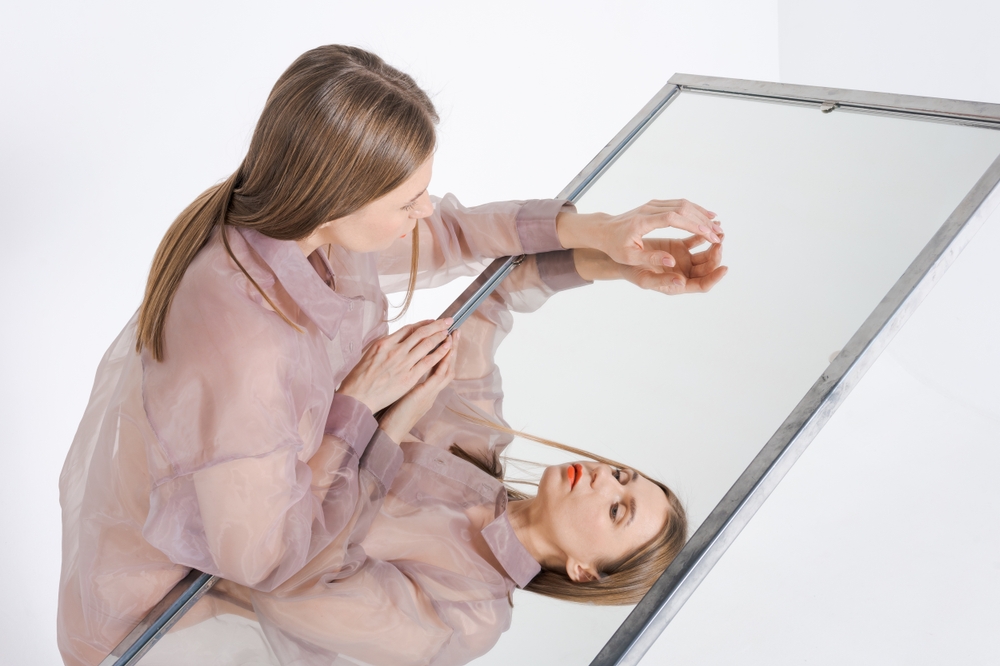
Mirror, Mirror, in my head….
That’s our inner mirror—the one that reflects our actions, motivations, habits, and behaviors.
Looking into the inner mirror starts with self-awareness: the practice of actively noticing our thoughts, emotions, beliefs, actions, and triggers. It’s a skill—one we can learn—and research consistently shows it’s a strong predictor of success in life. Highly self-aware people tend to be more open to growth, more resilient, and to have higher self-esteem.
Yet, this inner mirror is the one many of us quietly avoid. I can hear the phrase “Mirror, mirror in my head, you’re the one I often dread.”
Why?
Well, it’s hard call to ourselves out when we’ve done or said something we’d rather we hadn’t. Our minds would rather rationalize the situation—keeping us the good person—than admit wrongdoing and offer an apology.
Honestly looking at our shortcomings also can feel overwhelming—and so much a part of our identity that we don’t even know where to start to fix them. Plus, who would we be without our sarcasm, or our bossiness?
In a Psychology Today article, Tchiki Davis, Ph.D., offers a more sobering perspective: “Our minds are so busy with daily chatter that we usually only reflect when something has gone terribly wrong.”
Ouch.
Learning to Look Inward
Why wait until life falls apart to pause and reflect? With all the benefits we gain, we can make it a daily habit to look back at our day and see what went right and what went…not so right.
How do we actually do this?
Reflection might be as simple as pausing long enough at the end of the day to ask a few honest questions. Socrates famously said, “The unexamined life is not worth living.” Dramatic? Maybe. But he wasn’t wrong.
Because of my passion for personal growth, I choose to live an examined life. For me, that’s as simple as asking a few questions before going to sleep.
- What’s one thing I did really well today?
- What’s one lesson I learned?
- What’s one thing I’d do differently tomorrow?
Small questions. Big impact.
The idea isn’t to beat yourself up – it’s as much to see what went right, and how you can grow from what didn’t.
Without some level of examination, we move through life on autopilot: reacting instead of choosing, repeating patterns instead of learning from them.
When Reflection Becomes Too Much
Of course, there’s a flip side.
Too much reflection can turn into rumination—an endless mental loop where we fixate on what’s wrong. I’m reminded of the small, round magnifying mirror in my bathroom, the one I use for any wayward eyebrows. It magnifies everything about 30 times, which is great for grooming… and terrible for perspective.
That mirror doesn’t just show eyebrows. It reveals age spots, new creases, spider veins, and other imperfections. And that leads to mental hand-wringing about getting older, looking unattractive, and the darkest rumination of all: dying.
In a sense that damn mirror is the opposite of the wicked queen’s. Instead of inflating our ego, it amplifies our flaws. And when we’re prone to self-criticism, too much magnification—externally or internally—can distort reality.
Another reason why so many of us avoid looking inward at all.
A while back, I snapped at my dad. I knew from the look on his face that I hurt his feelings. But even though I apologized, that night I couldn’t stop baseball-batting myself. “What a rotten daughter you are.” “What if he dies tonight and that was our last interaction?” “I’d better go check and make sure he’s breathing.” On and on and on. I was up till 2 a.m. riding that scary-go-round of rumination. I finally let it go after another apology the next day.
Avoidance Has a Cost
The potential of ending up in that spin of rumination can tempt us to neglect the inner mirror entirely, but that’s not the solution.
When we do that, we stop growing. We become defined only by the surface reflection—what’s visible, comfortable, and familiar. No insight. No course correction. Just repetition.
Healthy self-reflection isn’t about tearing ourselves apart. It’s about learning, not judging.
So try asking yourself some simple questions at the end of the day and journal the answers. You’ll be becoming more self-aware, learning and growing.
The wicked queen only ever asked her mirror one question. Maybe the better question isn’t who’s the fairest of them all? but who am I becoming—and am I okay with that answer?




 rubyslippersredshoes